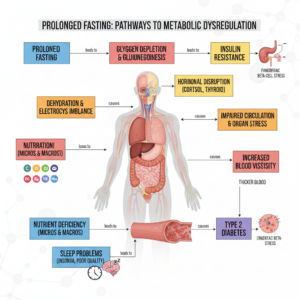
While prolonged fasting is often cited for its metabolic benefits, extended periods without caloric intake can trigger a “survival mode” that, if sustained, disrupts the very systems it aims to improve.

0
3

While prolonged fasting is often cited for its metabolic benefits, extended periods without caloric intake can trigger a "survival mode" that, if sustained, disrupts the very systems it aims to improve.  
Below is a condensed, in-depth analysis of the physiological pathways to metabolic dysregulation.
1. Glucose Dysregulation and Insulin Resistance
When glycogen stores (the body’s 12–24 hour glucose reserve) are exhausted, the body initiates gluconeogenesis—synthesizing glucose from non-carbohydrate sources like muscle tissue (amino acids) and fat (glycerol).
• The Randle Cycle: As the body ramps up fat oxidation, the resulting surge in Free Fatty Acids (FFAs) can inhibit glucose utilization in the muscles.  
• Hepatic Resistance: Constant gluconeogenesis forces the liver to stay in "production mode." Over time, the liver may become "deaf" to insulin's signal to stop producing glucose, a primary driver of Type 2 Diabetes.  
• Beta-Cell Exhaustion: To overcome this resistance, the pancreas overworks to secrete more insulin. Eventually, these beta-cells can reach a state of "burnout," leading to permanent insulin deficiency.  
2. The Endocrine Stress Response
The body perceives prolonged starvation as a high-stress event, causing a shift in the hypothalamic-pituitary-adrenal (HPA) axis.
• Cortisol Hypersecretion: To mobilize energy, the adrenal glands release cortisol. While helpful in the short term, chronic elevation impairs peripheral glucose uptake and promotes visceral fat storage.  
• Thyroid Downregulation: To conserve energy, the body reduces the conversion of Thyroxine (T4) into the active Triiodothyronine (T3). This "low T3 syndrome" slows the basal metabolic rate, often leading to rapid weight regain (the "yo-yo" effect) once fasting ends.
3. Hemodynamics and Blood Viscosity
Prolonged fasting can physically alter the properties of blood, increasing the risk of cardiovascular strain.
• Hemoconcentration: As insulin levels drop, the kidneys excrete sodium and water (natriuresis of fasting). This loss of plasma volume makes the blood more "viscous" or thicker.
• Erythrocyte Aggregation: High levels of circulating FFAs can coat red blood cells, reducing their "deformability." This makes it harder for blood to flow through tiny capillaries, potentially impairing oxygen delivery to vital organs.
4. Sleep and Circadian Disruption
The metabolic shift during fasting directly interferes with the sleep-wake cycle:
• Orexin Activation: Fasting stimulates orexin neurons in the brain, which promote wakefulness and alertness (an evolutionary trait to help find food), often leading to insomnia.  
• Cortisol/Melatonin Imbalance: Elevated nighttime cortisol counteracts melatonin production, preventing deep, restorative REM sleep.  
• Micronutrient Gaps: Deficiencies in magnesium (which regulates the GABA system) and tryptophan (a precursor to serotonin and melatonin) further degrade sleep quality.